Coronavirus: Human trial of a new vaccine begins in the UK
Coronavirus: Human trial of a new vaccine begins in the UK

Volunteers have been vaccinated with the UK's new coronavirus vaccine.
As part of a trial at Imperial College London led by Professor Robin Schultz and colleagues, about 300 people will have the vaccine in the coming weeks.
Tests in animals show that the vaccine is safe and that it stimulates an effective immune response.
Experts at Oxford University have already begun human trials.
Trials involve many people all over the world. There are about 120 vaccine programs.
Is coronavirus controlled in the UK?
Is it safe to relax the 2m rule?
How close are we to developing a vaccine?
'I volunteered to help defeat the virus'
Media caption Kathy is one of the first 300 volunteers to take part in this phase of the trial
Kathy, 39, who works in finance, is one of the first volunteers to take part in the imperial trial.
She said she volunteered because she wanted to take part in the fight against the virus.
"I think it really came down to not knowing what I could do to help, and it was something I could do.
"And to understand that it's unlikely that things will get back to normal unless there is a vaccine, so we want to be part of that development."
Following this first phase, another trial is planned for October, involving 6,000 people.
The Imperial team hopes the vaccine could be distributed in the UK and overseas by early 2021.
Social Anarchy: What are the rules now?
Bubbles: How do they work and who can you be?
Job: Can my boss force me to go to work?
Social life: When will pubs, bars and restaurants open?
Meanwhile, at the city's Churchill Hospital, the Duke of Cambridge met with volunteers attending the Oxford University trial.
Prince William told the volunteers: "This is the most amazing and wonderful and most welcome project that you are all doing, so it's exciting."
A new perspective
Many traditional vaccines are based on a weakened or modified form of the virus or parts of it, but the imperial vaccine is based on a new approach, which uses synthetic strands of the genetic code, called RNA. , Which mimics the virus.
Once injected into a muscle, the RNA expands itself - makes its own prescription - and instructs the body's own cells to make copies of the spike protein found outside the virus.
This should train the defense system to recognize and fight the coronavirus without developing coyote-19.
Because the imperial vaccine uses only a small amount of genetic code, it travels a little longer. The Imperial team says one liter of its synthetic material will be enough to produce two million meals.
Those foods are made in the United States, but manufacturing is turning to the UK later this year, so if and when it needs to be mass-produced, it can be done here.
All medical trials begin carefully and slowly to reduce safety risks. When the Oxford vaccine began in April, only two volunteers were vaccinated on the first day. Within a week, 100 were being redeemed daily.
The unique nature of the imperial vaccine means that only one volunteer will be vaccinated on the first day, and three more will be vaccinated every 48 hours thereafter. In a week or so, the numbers will gradually increase.
Unlike the Oxford vaccine, which uses a single dose, volunteers on the imperial trial will receive two tablets in addition to four branches.
Professor Shtuck and his team say they have no particular safety concerns - it's just a new approach to their approach, which is why they're proceeding cautiously.
There are more than 120 coronavirus vaccines in early development worldwide. Most of them will never be able to go beyond the laboratory. Another 13 are now in clinical trials: five in China, three in the United States, two in the United Kingdom, Australia, Germany, and Russia.
All the vaccine teams want to put pressure on them that they are not against each other, but against the virus. If enough food is needed to protect the world, several vaccine approaches will need to be successful.
Professor Stuck said: "We have been able to develop a vaccine from the beginning and we can take it to human trials in just a few months.
"If our approach works and the vaccine provides effective protection against the disease, it could revolutionize how we respond to future disease outbreaks."
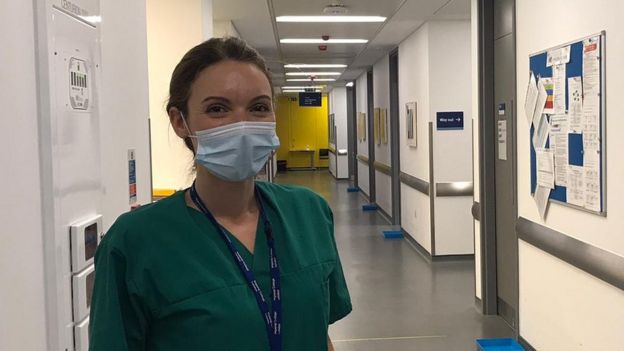
Chief Investigator Dr. Katrina Pollock hopes the vaccine will work
Dr. Katrina Pollock, the study's chief investigator, added: "If I'm not cautiously optimistic, we'll see a strong resistance in our participants.
"Pre-clinical data are very encouraging. We are getting a neutral antibody response that is an immune response that you want to protect against infection. But it is still a long way to go to evaluate this vaccine."
The research has been funded by £41m from the UK government, as well as £5m of other donations.


Comments
Post a Comment